

Top 5 best anti dark spot creams
Discover the TOP 5 anti dark spot creams for your skincare. Find the perfect ally to show off radiant, uniform skin. Don’t miss out!


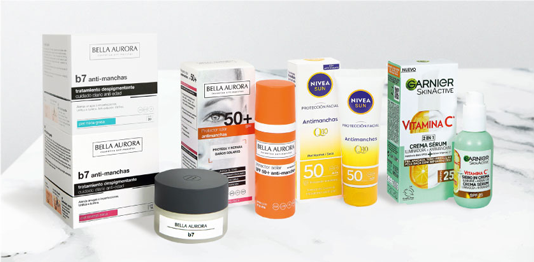
Best anti dark spot cream recommended by dermatologists
We need to be careful with dark spots that appear or are made worse by the sun, since if we continue to expose ourselves to the sun, they will either reappear or will worsen.
Melasma, as it is known, is a type of spot or mark that is affected by hormones and it is therefore one of the most difficult ones to treat since it is sensitive to extreme sunlight. Treating melasma has to be continuous throughout the year. Complete depigmentation can be achieved, but hyperpigmentation can reappear.
Some of the most effective treatments for skin spots are creams and depigmenting peeling, and also the use of certain laser and light source treatments under control by dermatologists. Photoprotection throughout the year is fundamental to avoid dark spots from appearing or spreading.
According to the Spanish Dermatology Academy there are many depigmenting agents that can improve the aspect of dark spots, although treatment needs to be individual for each problem and skin type. Hydroquinone and its derivatives, retinoic acid, retinol, kojic acid, azelaic acid, vitamin C, etc., are some of the most noteworthy, which we can find in anti dark spot creams.
There are many different available options:
Anti dark spot creams, anti dark spot serum antimanchas, for dry skin…
Anti dark spot creams that include sun protection factor.

Best anti dark spot hand cream
Our hands tend to give away our age, and we should therefore look after them. Our hands suffer the most through their constant exposure to the sun, extreme temperatures, wind, chemicals, etc.
Our hands can show many signs of the passing of time, such as dehydration, roughness, lack of glow, etc. But perhaps the thing that we are most concerned with are dark spots.
Visiting a dermatologist is advisable to assess and determine what they actually are before choosing the right way to treat them.
There are also some general guidelines to care for our hands, such as the use of mild cleansers, using any excess face products to rub into our hands after applying them to our face, since they have high active ingredient concentrations, avoiding direct exposure to the sun during the middle of the day, using SPF for our hands (hand care products with filters have become popular). We can also use anti-ageing formulae designed specifically for our hands.
Types of dark spots that can appear on your skin
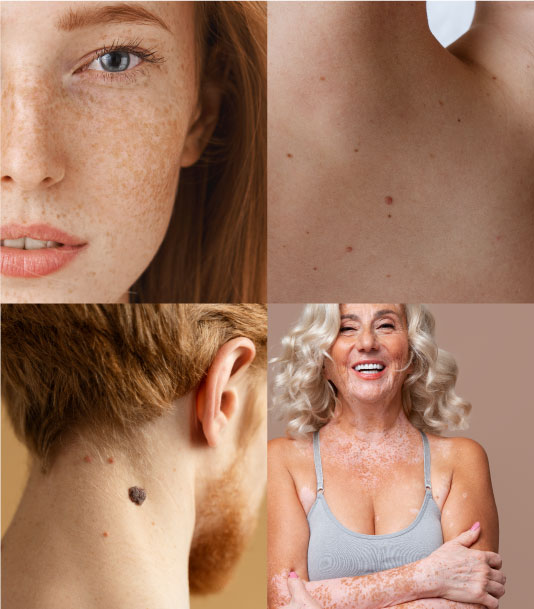
Dark spots on our skin are caused by uneven distribution of melanin and the cells called melanocytes that produce it. Melanin is the pigment that protects us from the sun’s rays. Therefore, the more we expose ourselves to the sun, the more melanin our melanocytes secrete.We can find the following different types of dark spots:
Freckles: are accumulations of brownish pigment which tend to be round and randomly shaped. They are usually found on areas exposed to the sun such as our neck and arms, particularly on people with white skin.
Moles: are accumulations of a higher number of melanocytes that affect the different structures of our skin. It is important to see a dermatologist if our moles are not symmetrical, if they change colour or the colour is not uniform, if they have irregular edges and change size.
Melanomas: are malignant tumours of the skin that can be confused with moles that grow gradually.
Simple or sun lentigines: are small brownish spots that can appear anywhere on our body, and unlike freckles they do not change colour when exposed to the sun.
Melasma: are light or dark brown spots that appear almost exclusively on women. They appear or worsen during pregnancy (chloasma), when taking contraceptives or during the menopause. They mainly appear on the forehead and cheeks, after reaching around 30 years old.
Vitiligo: are white, well-defined spots, symmetrically distributed, that are most common on legs, around our eyes, nose and mouth. They are thought to have an autoimmune origin and are sometimes related to thyroid problems.
Other spots: red (vascular origin) or brown, such as “café au lait” spots in various shapes and sizes, commonly known as birthmarks.
What do you think about?
Share comments, opinions and tricks with the Community