

How to remove mud stains from clothes and trainers
Discover how to remove mud stains from clothes, trainers and white garments step by step, with and without baking powder. Household remedies that really work.

A walk in the rain, a match on a muddy pitch or an afternoon in the park can leave an unwelcome souvenir on trousers, T-shirts and trainers. The good news is that knowing how to remove mud stains from clothes is relatively easy and does not require miracle products: the key, above all, is not to rush things.
In fact, mud is an exception to the usual rule for stains: it is better to let it dry before cleaning it. If you rub it while it is still damp, it can spread and work itself deeper into the fibres. We also recommend treating stains before putting the garment in the washing machine. But first let’s go step by step.
How to remove mud stains from clothes step by step
If you are wondering how to remove mud stains, start by removing as much dirt as possible without wetting the garment yet. Take note!
- Let the mud dry completely. It may seem to go against the grain, but once dry it is much easier to work on.
- Brush off the residue. Use a clothes brush or a soft-bristled brush. For a large stain, you can shake the garment outdoors first.
- Pre-treat the area. Apply liquid detergent directly to the stain and gently knead it into the fabric. Liquid detergents are particularly useful for treating smaller stains.
- Rinse and check the result. If there is still a visible mark, repeat the pre-treatment process before washing.
- Wash following the washing instructions on the label. Remember that the right programme depends on the fabric and the manufacturer's instructions.
One more important detail: do not put a mud-covered garment straight into the washing machine. Removing the solid dirt first stops the wash having to deal with an unnecessary amount of soil.

How to remove dried mud stains
Older stains need a little more patience, but not necessarily harsher products. To find out how to remove dried mud stains from white clothes or coloured clothes, the first step is still the same: dry-brush away anything that will come off.
If the stain has been there a while, brush carefully several times and then apply liquid detergent to any remaining marks. Leave it to work for a few minutes and wash the garment following the instructions on the label. In general, treating smaller stains before the wash improves results against stubborn stains.
On delicate garments, or those that can only be dry-cleaned, it is best not to experiment with home remedies.
How to remove mud stains from white clothes
White clothing allows you to turn to active oxygen whitening products, depending on the type of fabric. This type of product can help when a greyish or yellowish mark remains after removing the mud and washing the garment. Sodium percarbonate is often highlighted as an alternative to bleach for certain stains, and it can also be used on coloured garments, always following the product's instructions.
Therefore, if you are wondering how to remove mud stains from white clothes, a reasonable strategy is: dry, brush, pre-treat with detergent and, if the mark persists, use an active oxygen product suitable for that type of fabric.
In any event, extra care should be taken with whitening products on coloured clothing. Detergents with specific formulae for coloured clothes do not contain whitening agents and are designed to protect pigments better. So, if you are wondering how to remove mud stains from coloured clothes, always start with the gentlest method and save specific products for when they are actually necessary.

How to remove mud stains from trainers
In the case of trainers too, the material dictates how we can clean them. Before wetting a pair of trainers, check whether they are canvas, mesh, leather, suede or synthetic materials.
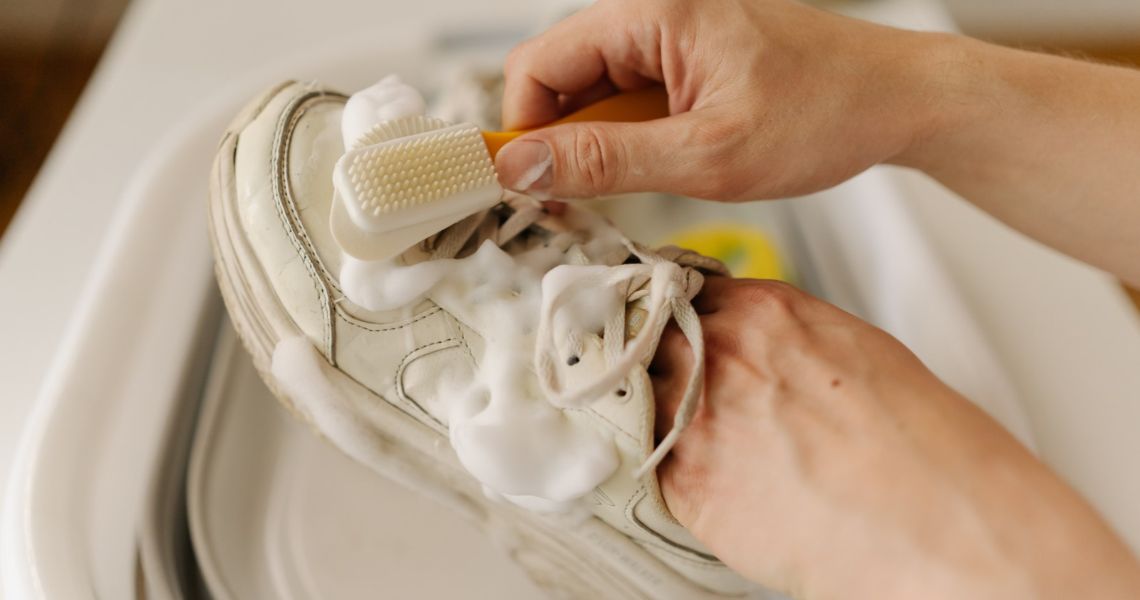
For washable fabric trainers, let the mud dry and then brush it off. This is precisely the general procedure for muddy footwear: dry, shake, brush and then move on to cleaning with mild detergent and warm water.
Once most of the mud has been removed, clean the surface with a cloth or soft brush dampened with a small amount of detergent. The rubber sole can be worked a little harder, but the fabric needs gentle movements to avoid damaging it.
Baking powder and vinegar remedies for mud stains
Baking powder can be useful as a cleaning aid, but a classic myth is worth debunking: mixing baking powder and vinegar does not turn the two products into a more powerful stain remover.
Therefore, if you want to remove mud stains with baking powder, it is best to use it on its own: you can make a small paste of baking powder and water to work on a stubborn mark on a suitable fabric, always testing first on a hidden area. For smelly trainers, dry baking powder can also be used and then completely shaken out afterwards.
As for vinegar, it has other household uses, but there is no need to systematically use it to clean off mud. Above all, it must never be mixed with bleach, as this can produce dangerous gases.
How to wash the garment in the machine for a perfect finish
Once you have pre-treated the stain, it is time for the washing machine. Sort the garment by colour and fabric type and choose a suitable programme according to the label. There is no need to fill the drum with products: bear in mind, too, that using more detergent does not mean cleaner clothes.
Before hanging the garment out, check that the stain has gone completely. However, since, if a ring is still visible, it is best to repeat the treatment and wash it rather than apply heat. Drying should be in accordance with the drying instructions on the label, and if in doubt, air-dry it.
In short, the formula for knowing how to remove mud stains from clothes is considerably less complicated than it would appear at first sight: let it dry, brush, pre-treat, wash and check before drying. As for trainers, one extra rule: always adapt the cleaning to the material.
As you can see, with the right remedies and a good deal of patience, mud that once seemed destined to stay on forever can end up becoming just an anecdote (fortunately!).
What do you think about?
Share comments, opinions and tricks with the Community