
How to encourage relaxation in children
Learn relaxation techniques for children using simple exercises that help to reduce stress, improve concentration and foster wellbeing.

In this increasingly fast-paced world, children can also feel the weight of stress: school pressure, screens, everyday worries, constant change… That is why including relaxation routines for children is not a luxury but a real necessity. They not only help to make them feel better, but they also enhance their concentration, emotional balance and their ability to self-regulate in difficult times. Appropriate techniques, adapted to their age, can make a big difference to a child’s wellbeing and development.
In this article, we provide some children’s relaxation exercises and music designed to help them unwind, and we delve into the main benefits that these practices bring to children’s everyday lives.
Benefits of relaxation techniques for children
Relaxation techniques offer many benefits for children’s wellbeing. According to experts and applied psychology studies, they help to reduce muscle tension, reduce anxiety and promote a sense of inner calm. It has also been shown that, with regular practice, children develop better emotional control, increased self-esteem and improved concentration and memory.
Bearing in mind that chronic stress in childhood can negatively affect learning and overall health, introducing these practices from an early age contributes to building greater self-regulation, teaching children to recognise feelings of restlessness and to consciously calm themselves. The benefits of relaxation techniques are evident both at home and within the school environment.
6 exercises and relaxation techniques for children
Here are six simple suggestions that are perfect for inclusion in the family or school routine:
- Deep breathing (4-7-8 technique). Children inhale for 4 counts, hold their breath for 7 and exhale for 8. This technique helps activate the parasympathetic nervous system which promotes calm and is recommended for reducing stress and anxiety.
- Progressive muscle relaxation (Jacobson). This consists of tensing and then relaxing muscle groups (legs, arms, face…), focusing on the sensation of relief. A classic exercise which has been shown to reduce anxiety and improve rest.
- Guided imagery (visualisation). The child is asked to close their eyes, breathe slowly and create a calm mental scene (a beach, a forest, a garden…) using their senses (sight, sound, touch) to deepen the feeling of tranquillity.
- Children’s yoga. Mindfulness and relaxation are promoted through adapted poses, breathing exercises and gentle movement. Some studies show that this improves concentration, reduces tension and helps the child to connect with their body.
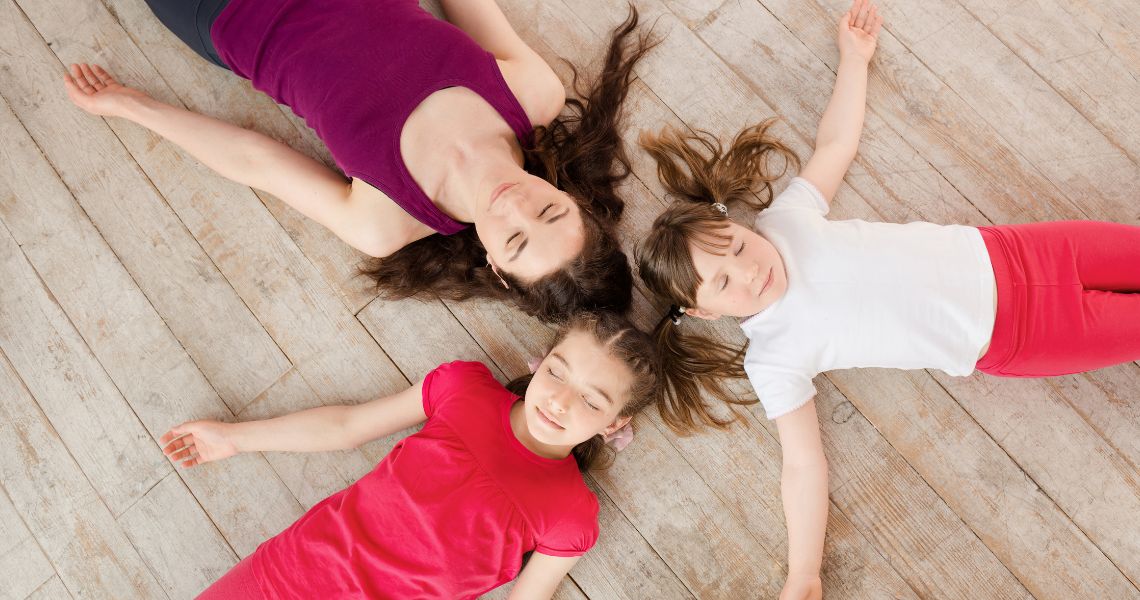
- The stretching star (mindful stretches). A very simple and effective technique to relax body and mind. It consists of asking the child to imagine that they are a star that is growing and stretching in all directions: arms up, legs down, arms to the sides… always accompanied by slow breaths. Then, the star “shrinks” little by little, making itself small again. This releases muscle tension, improves body awareness and naturally reduces stimulation.
- Guided relaxation games. Games like the “calm jar” or “imagining bubbles” encourage slow breathing while the child visualises something peaceful. This game uses play to help internalise deep breathing.
How music supports children’s relaxation
Music plays a fundamental role in children’s relaxation. Various scientific studies show that certain types of music can regulate breathing and encourage a state of reduced physical activity. Children tend to breathe more slowly when listening to gentle melodies, slow rhythms and harmonious tones, which helps to reduce anxiety.
Sounds from nature, string instruments or melodies without lyrics also support guided visualisation and meditation. Music, therefore, helps to regulate emotional states and provides safe sensory support for children to build their own experience of calm.
How to incorporate play into children’s relaxation exercises
Play is the natural way for children to learn, which makes it an excellent vehicle for teaching relaxation techniques. Incorporating fun into the exercises enables children to adopt these practices without viewing them as a chore. As you have seen, this can be done in all the exercises. All you need is a little bit of imagination. For example, in breathing exercises, the child can imagine they are an animal that blows bubbles; in the relaxation exercises, they can be a little rag doll, and in the imagination exercises, they can be going on a magical journey.
The inclusion of relaxation in children’s daily routines is not just a tool for stressful times, but an investment in their emotional and cognitive development. With simple exercises, appropriate music and guided games, young children can learn to recognise their emotions, reduce their worries and improve their concentration. When applied consistently and respectfully, children’s relaxation becomes a powerful tool for fostering resilience and wellbeing from an early age. Are you ready to give it a try?
What do you think about?
Share comments, opinions and tricks with the Community